We say a number \(L\) is the limit of a function \(f(x)\) as its variable \(x\) approaches a number \(c\), if the function’s output values \(f(x)\) approach \(L\) when \(x\) get closer to \(c\).
We write this symbolically as:
\[
\large
\lim_{x\to c} f(x)=L
\]
We read this as: “The limit of \(f(x)\) as \(x\) approaches \(c\) is \(L\).”
Limits example: numerical
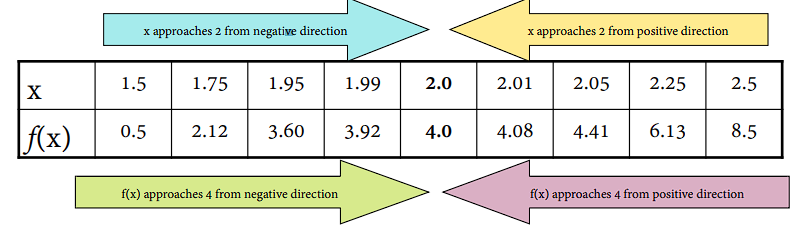
What is the limit of \(f(x)=2x^2-4\) as \(x\) approaches 2?
We need to examine the values of \(f(x)\) as \(x\) gets closer to 2 from both sides.
Limits example: numerical
What is the limit of \(f(x)=2x^2-4\) as \(x\) approaches 2?
We need to examine the values of \(f(x)\) as \(x\) gets closer to 2 from both sides.
✏️
Limits example: numerical
What is the limit of \(f(x)=2x^2-4\) as \(x\) approaches 2?
We need to examine the values of \(f(x)\) as \(x\) gets closer to 2 from both sides.
From both directions it looks like \(f(x)\) converges to 4.
So, we say that “The limit of \(2x^2-4\) as \(x\) approaches 2 is 4”. We can write it like this:
\[
\lim_{x\to 2}(2x^2-4)=4
\]
Limits example: graph
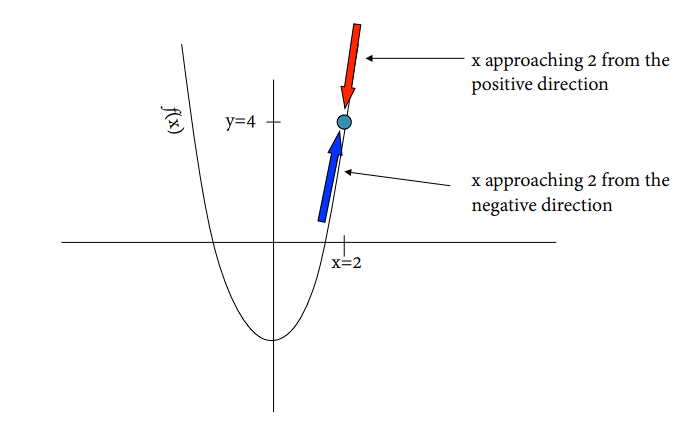
What is the limit of \(f(x)=2x^2-4\) as \(x\) approaches 2?
From both directions it looks like \(f(x)\) converges to 4.
So, \(\lim_{x\to 2}(2x^2-4)=4\).
Do limits always exist?
✏️
Do limits always exist?
The function \(|x|\) is the absolute value function. It is such that
\[
|x| =
\begin{cases}
x, & \text{ if } x\geq 0 \\
-x, & \text{ if } x <0
\end{cases}
.
\]
✏️ Exercise
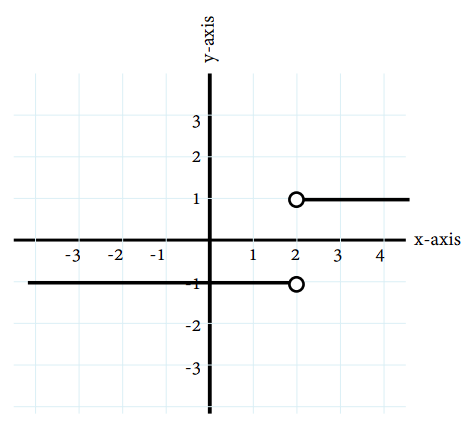
Let \(f(x) = \frac{|x-2|}{x-2}\). What happens to \(f(x)\) at \(x=2\)?
Try calculating:
\[
\lim_{x\to 2}\frac{|x-2|}{x-2}.
\]
Hint: Try to do numerical approximations or draw the graph of \(f(x)\).
Do limits always exist?
✏️ Let’s see a solution
Let \(f(x) = \frac{|x-2|}{x-2}\). What happens to \(f(x)\) at \(x=2\)?
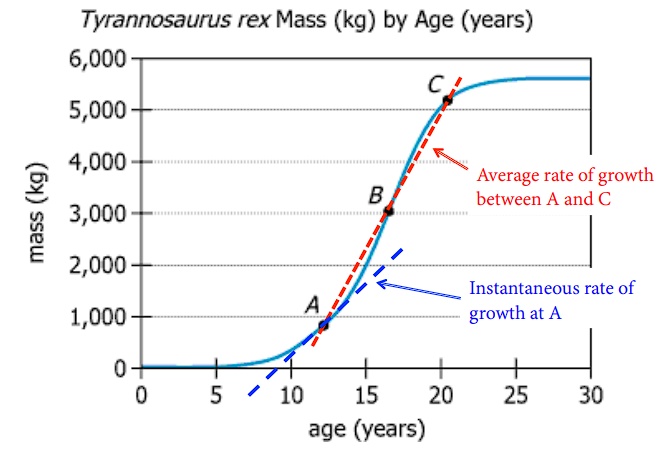
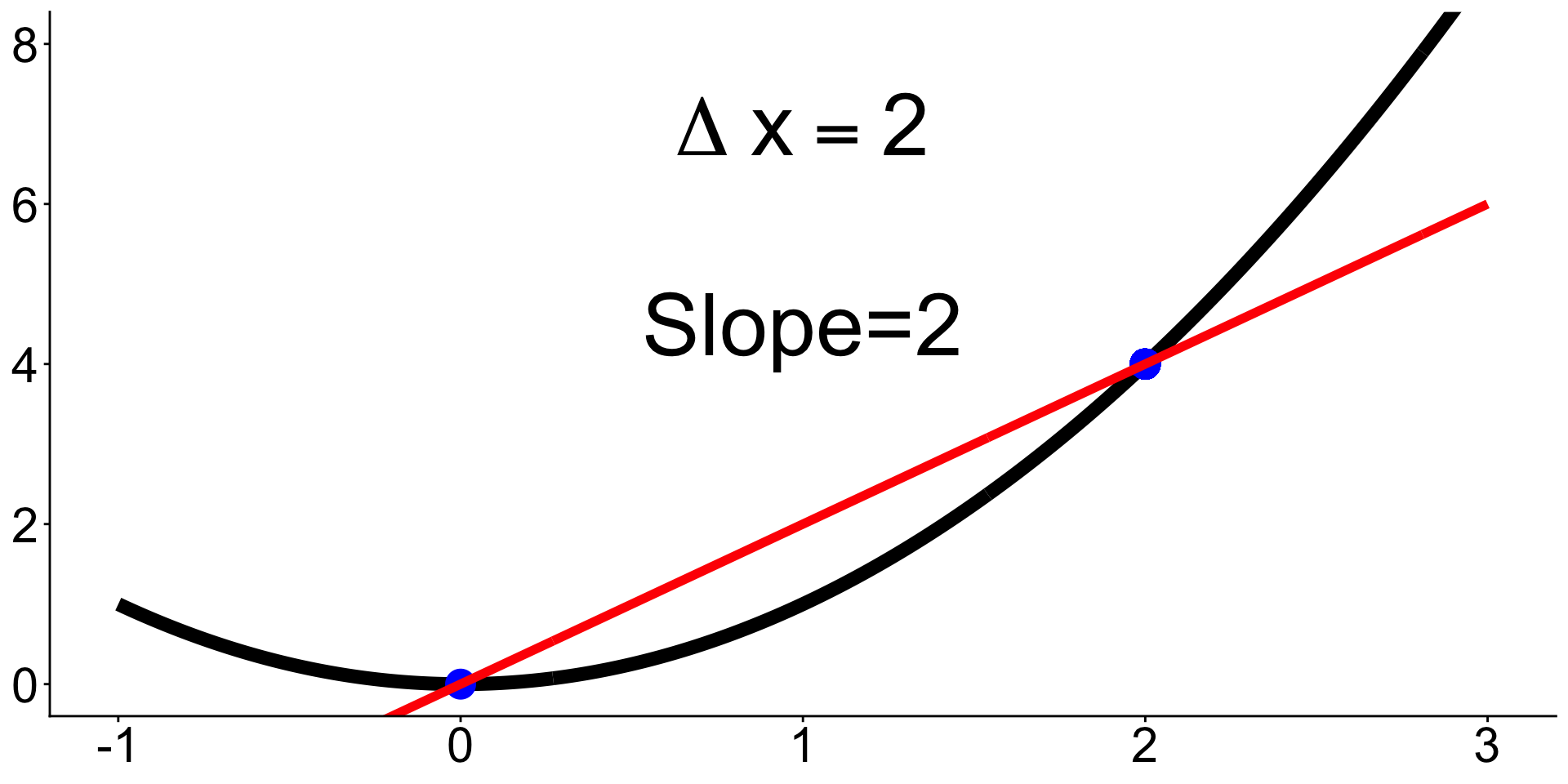
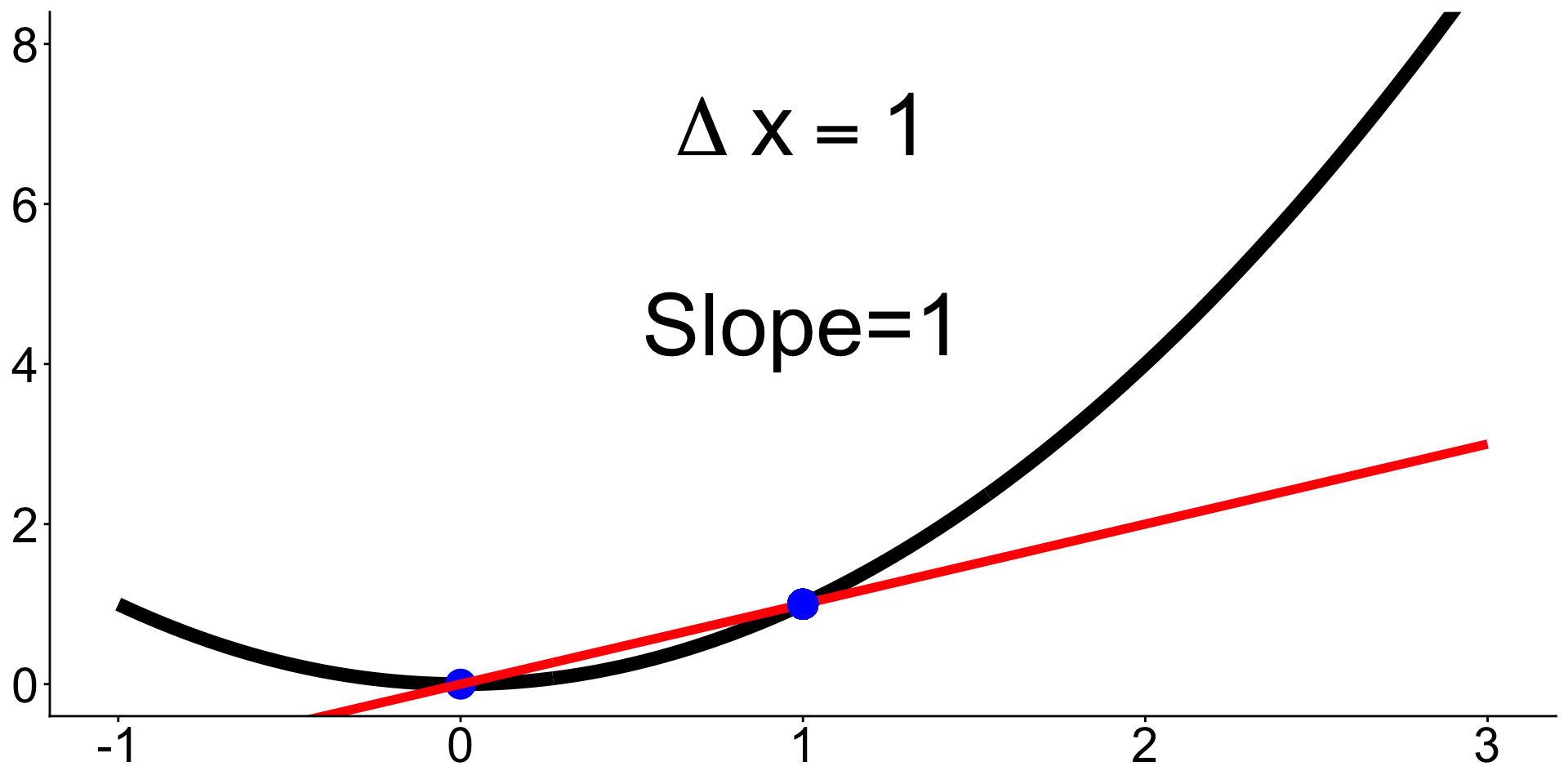
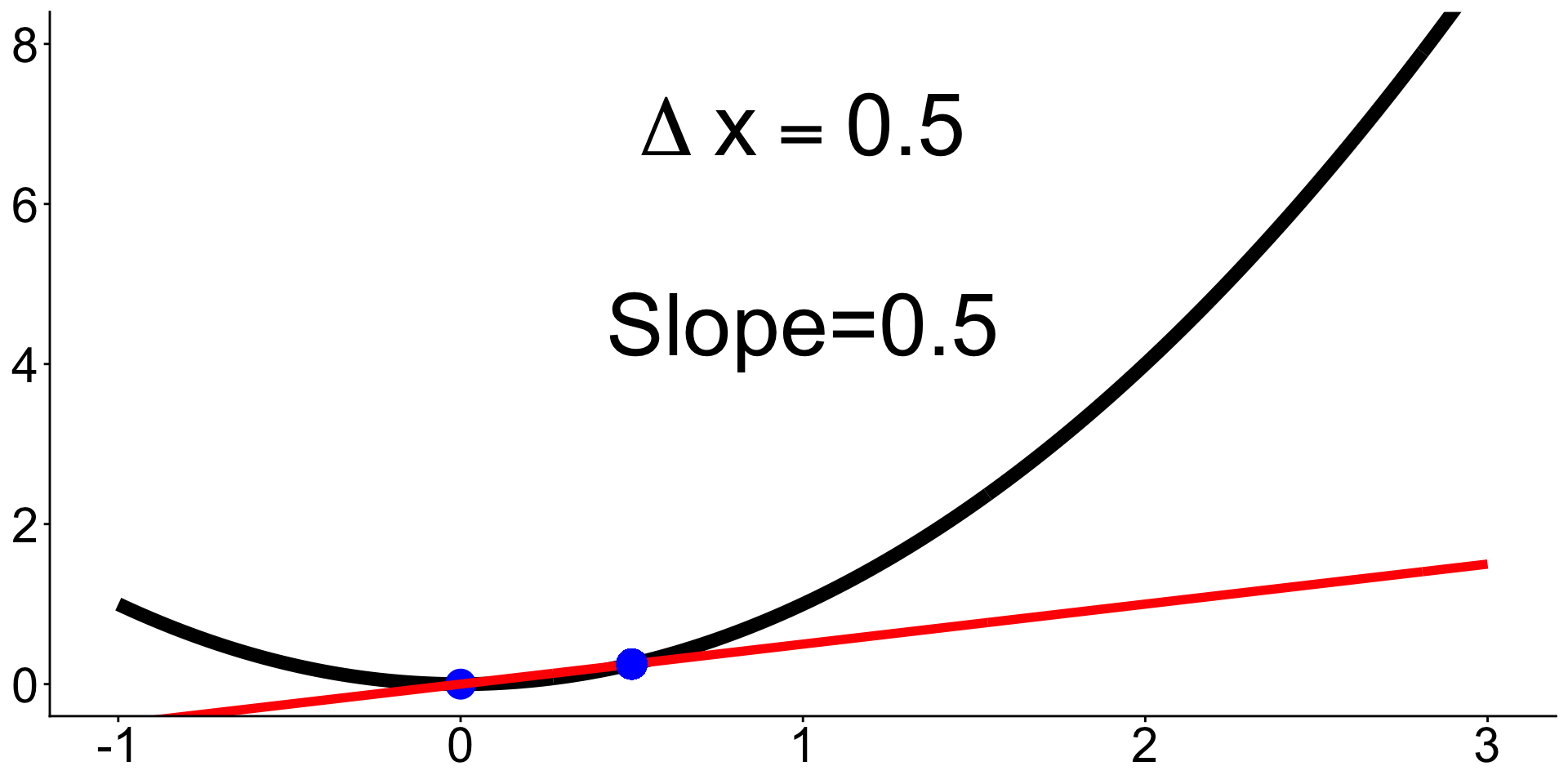
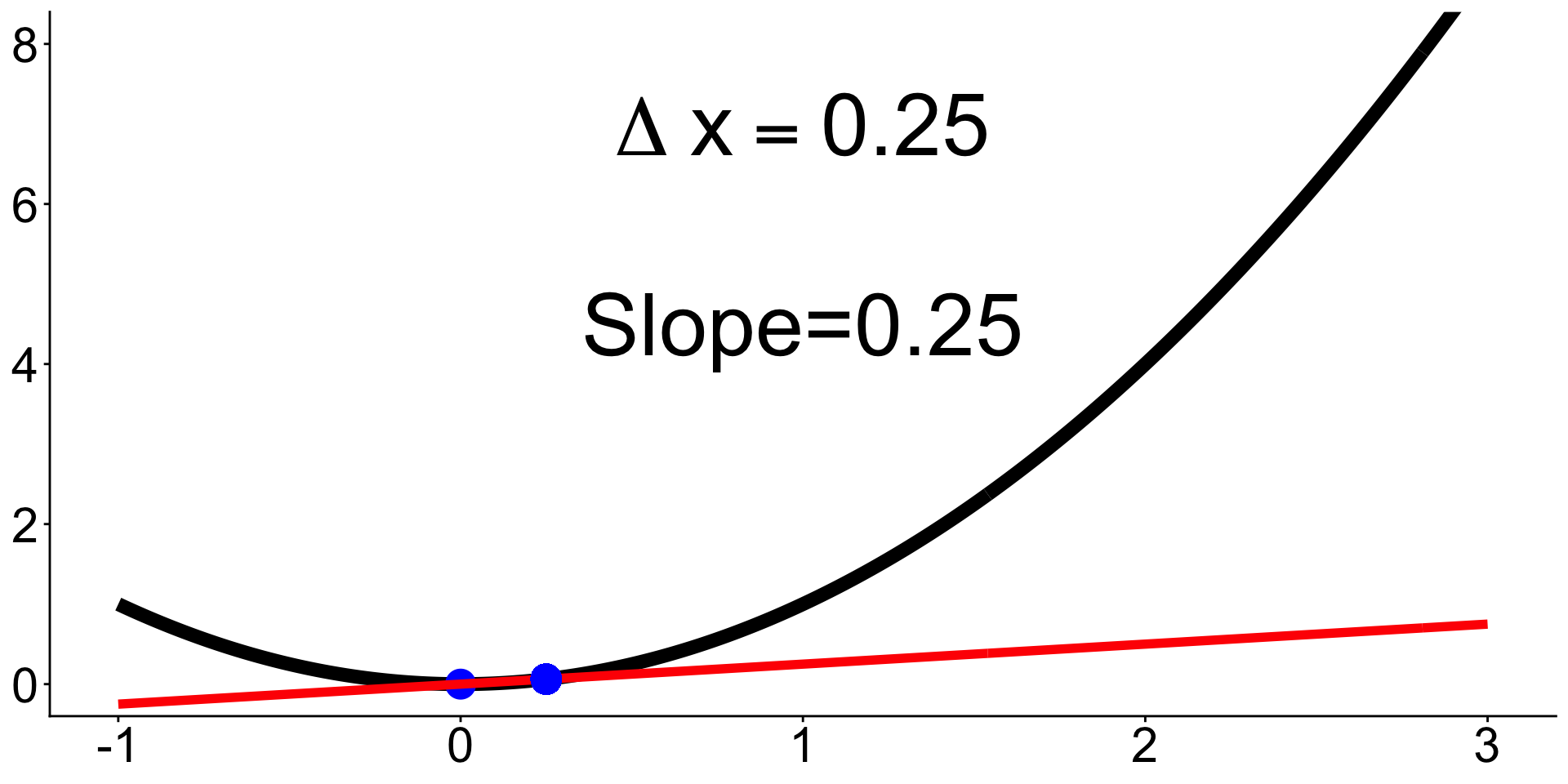
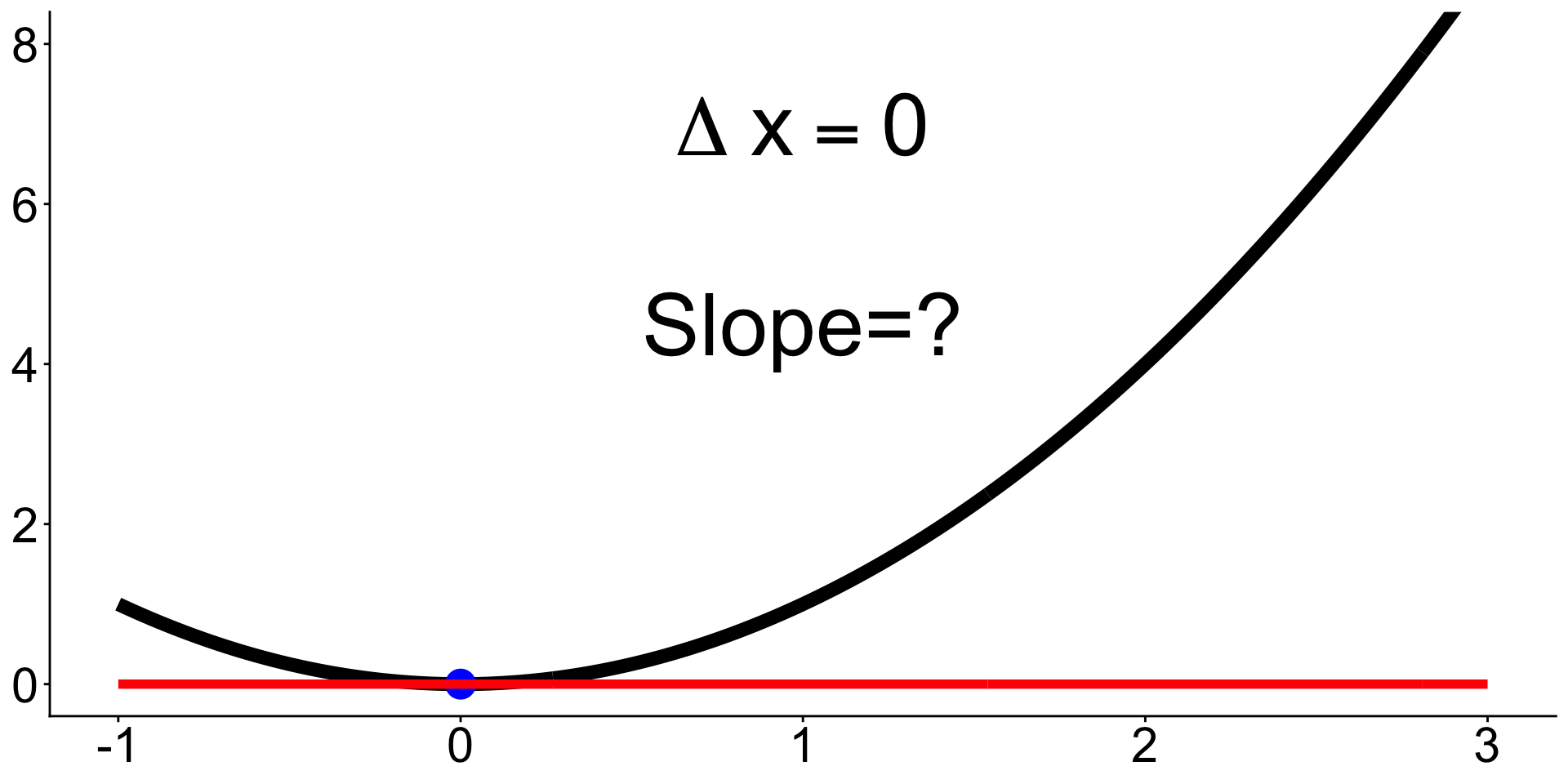
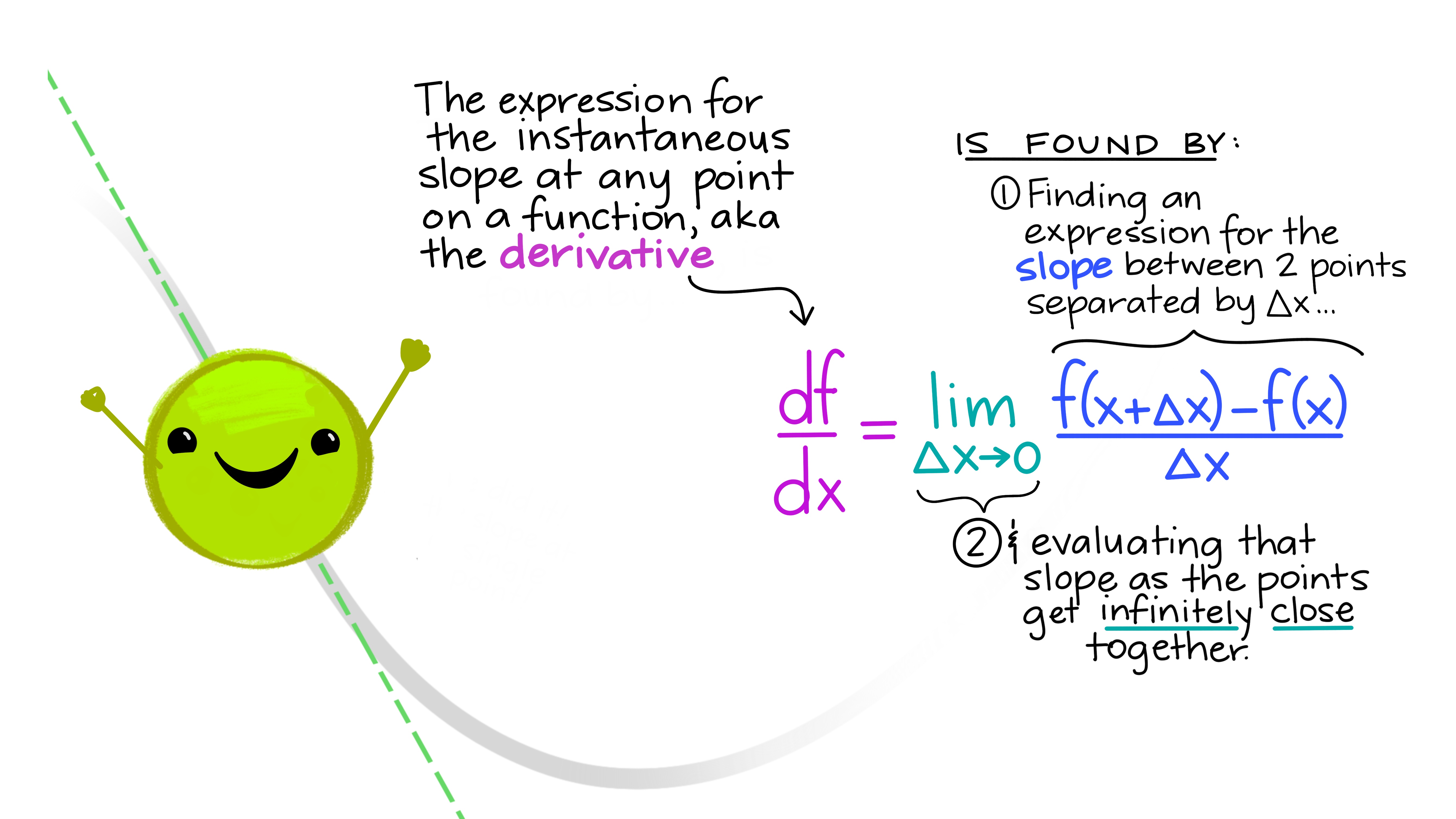
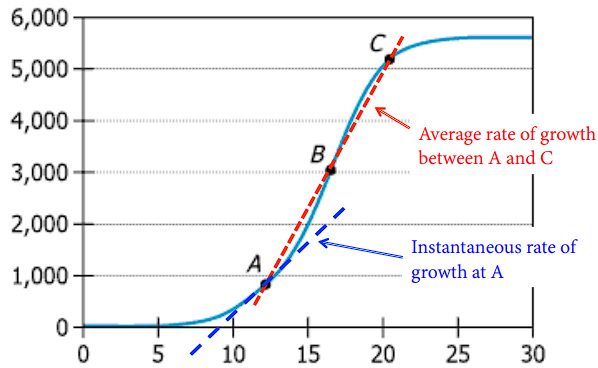
When we let \(\Delta x \to 0\) we get the slope of the tangent line at \(x\)
\[
\large
f'(x)=\lim_{\Delta x \to 0} \frac{f(x+\Delta x)-f(x)}{\Delta x}
\]
This is the derivative of \(f\) at \(x\). Also denoted \(\frac{df}{dx}\).
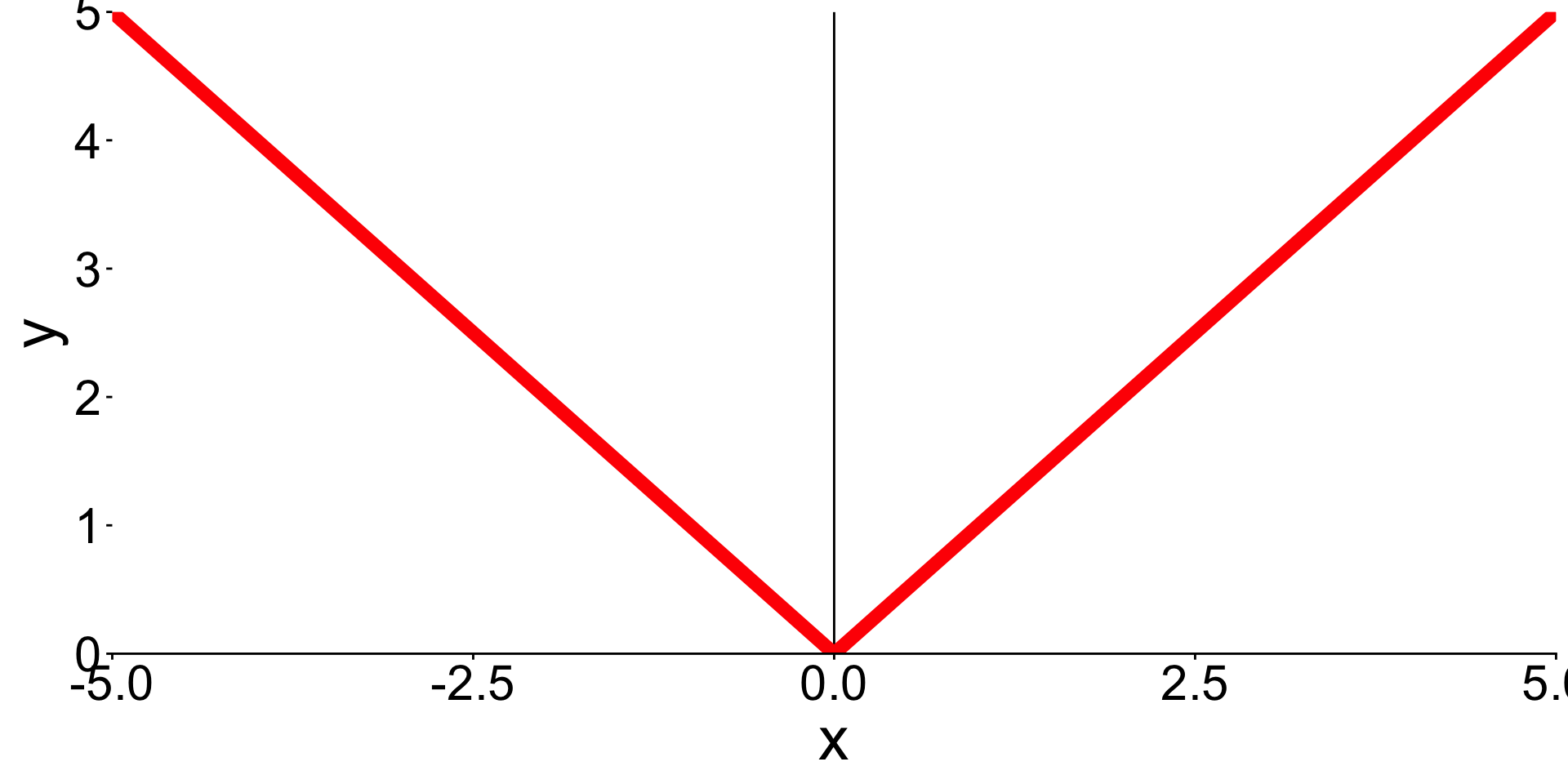
Not all functions are differentiable
The absolute value function \(|x|\) is one example, this is defined by \[|x| =
\begin{cases}
x &, x \geq 0\\
-x &, x<0
\end{cases}.\]
It’s graph is:
Why derivatives in an EDS program?
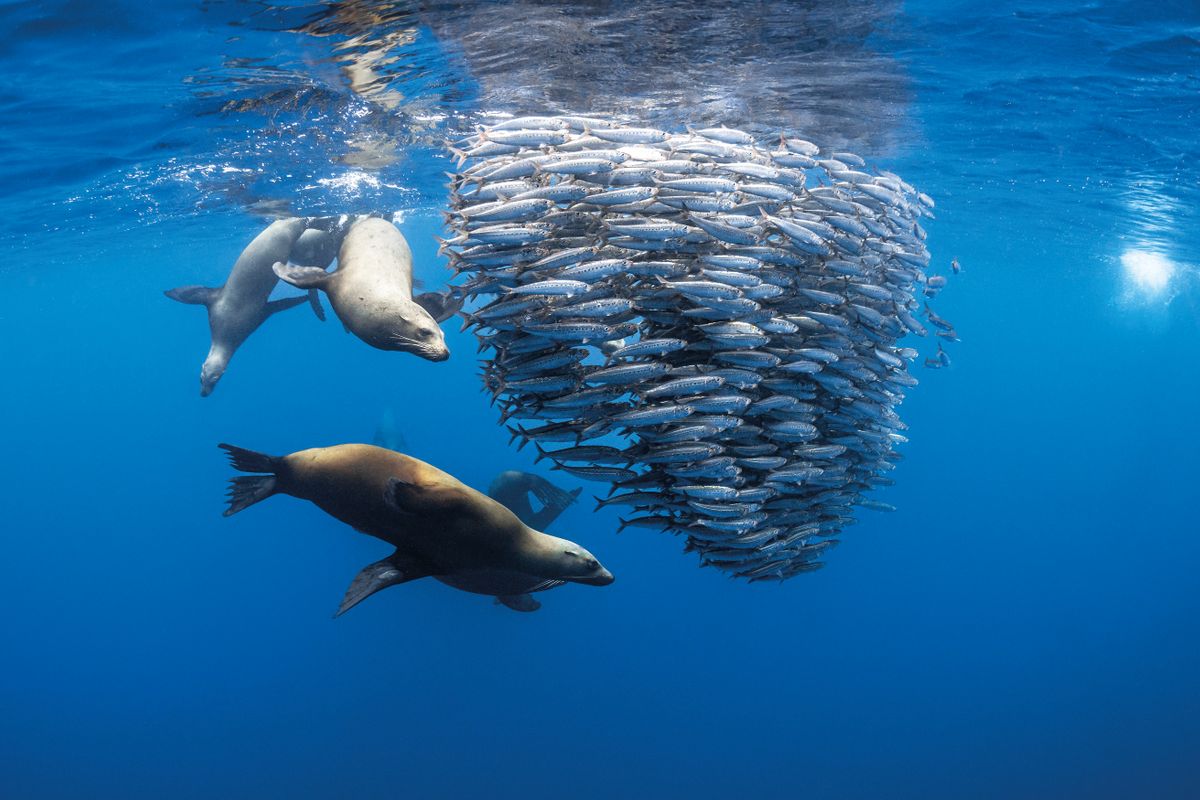
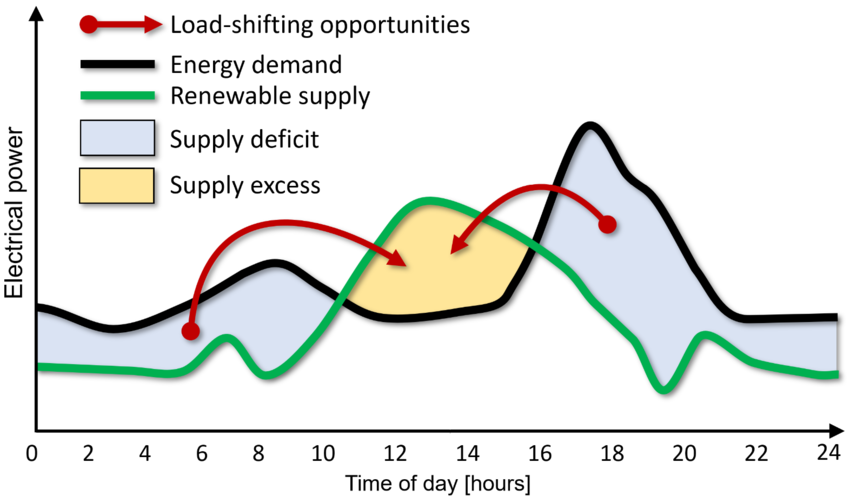
Describing rates of change is common in environmental science (rate of pollutant concentration change, rate of population growth, rate of energy consumption)
Calculus and derivatives are used to study change
Environmental Science studies change
Environmental Science studies change
Environmental Science studies change
🤔 Talk with a partner, what are 2 fields of environmental science where studying the rate of change and derivatives would be important?
Let’s take a 5 minute break
image: Flaticon.com
Rules for differentiation (1)
Constant Rule ✏️
Power Rule ✏️
Rules for differentiation (1)
Constant Rule
Let \(c\) be a constant (so, a number). If \(f(x) = c\), then \(f'(x)=0\). Equivalently
\[\frac{d}{dx}c = 0\]
Power Rule
Let \(n\) be a (real) number, if \(f(x)= x^n\), then \(f'(x) = nx^{n-1}\). Equivalently \[
\frac{d}{dx}[x^n]
=nx^{n-1}.
\]
😵All this says is: if the function has pieces that are added or subtracted you can take the derivative of each individual piece and add those derivatives.
The \(\frac{d}{dx}\) notation can be a lot here, the prime notation is a bit better:
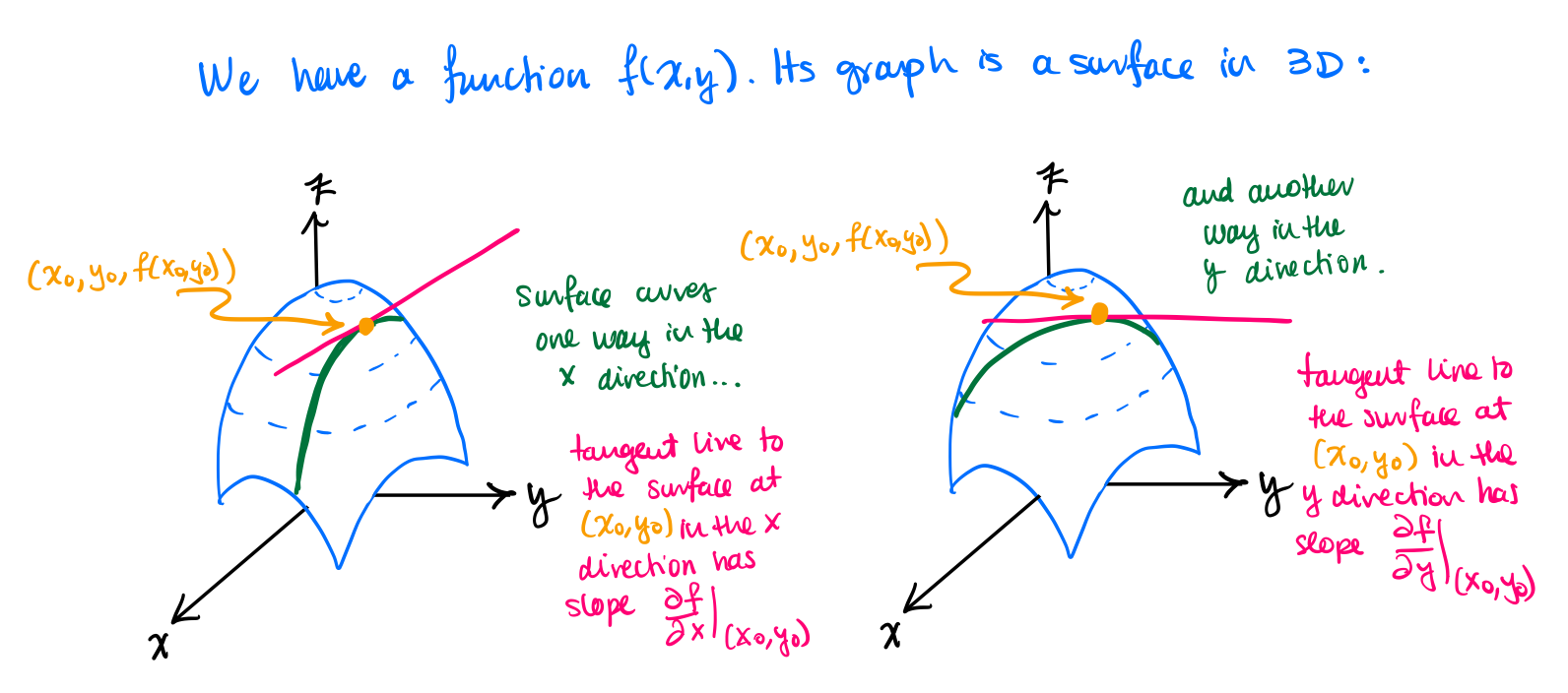
When we find a partial derivative, we find an expression for the slope with respect to one variable in a multivariate function.
Notation: the partials of \(f(x,y,z)\) are \(\frac{\partial f}{\partial x}\), \(\frac{\partial f}{\partial y}\), and \(\frac{\partial f}{\partial z}\)
We read \(\frac{\partial f}{\partial x}\) as “the partial derivative of \(f\) with respect to \(x\)”
How to take partial derivatives? Find the derivative with respect to a single variable, treating all others as constants.
OK, but what do partials actually mean?
The slope with respect to one variable if other variables are held constant.
\(\frac{\partial f}{\partial x}\) evaluated at \((x_0,y_0)\) can be written as \(\left.\frac{\partial f}{\partial x}\right|_{(x_0,y_0)}\) and tells us the slope of \(f\) in the \(x\)-direction, while \(y\) is held fixed at \(y_0\).
The temperature (in Celsius) across a surface (where \(x\) and \(y\) are in meters) is described by:
\[T(x,y)=x^2y-2x+y-1\]
At what “rate” is temperature changing (with respect to distance):
In the \(x\) direction, at the point (1,3) on the surface?
In the \(y\) direction, at the point (0,2) on the surface?
Write your answer as a complete sentence involving rate of change.
A dragon’s breath temperature (\(T\), in degrees Celsius) is modeled as a function of its wingspan (\(W\), in meters) and length (\(L\), also in meters):
\[T(W,L)=0.41WL+2.6W^2\]
At what rate is breath temperature changing with respect to length for a dragon that is 4.1m long, with a wingspan of 4.5m?
At what rate is breath temperature changing with respect to wingspan, for the same dragon?
Write your answer as a complete sentence involving rate of change.
Partial derivatives practice
✏️ Let’s see a solution.
The temperature (in Celsius) across a surface (where \(x\) and \(y\) are in meters) is described by:
\[T(x,y)=x^2y-2x+y-1\]
At what “rate” is temperature changing (with respect to distance):
In the \(x\) direction, at the point (1,3) on the surface?
In the \(y\) direction, at the point (0,2) on the surface?
Partial derivatives practice
✏️ Let’s see a solution.
The temperature (in Celsius) across a surface (where \(x\) and \(y\) are in meters) is described by:
\[T(x,y)=x^2y-2x+y-1\]
At what “rate” is temperature changing (with respect to distance):
In the \(x\) direction, at the point (1,3) on the surface?
In the \(y\) direction, at the point (0,2) on the surface?
A dragon’s breath temperature (\(T\), in degrees Celsius) is modeled as a function of its wingspan (\(W\), in meters) and length (\(L\), also in meters):
\[T(W,L)=0.41WL+2.6W^2\]
At what rate is breath temperature changing with respect to length for a dragon that is 4.1m long, with a wingspan of 4.5m?
At what rate is breath temperature changing with respect to wingspan, for the same dragon?
Partial derivatives practice
✏️ Let’s see a solution.
A dragon’s breath temperature (\(T\), in degrees Celsius) is modeled as a function of its wingspan (\(W\), in meters) and length (\(L\), also in meters):
\[T(W,L)=0.41WL+2.6W^2\]
At what rate is breath temperature changing with respect to length for a dragon that is 4.1m long, with a wingspan of 4.5m?
At what rate is breath temperature changing with respect to wingspan, for the same dragon?
Example: higher order & partial derivatives in environmental data science
The Advection-Dispersion-Reaction Equation for solute transport models the change in a solute concentration \(C\) over time \(t\) and \(x,y,z\) space, where groundwater is flowing in direction \(x\):